
Enterprise CRM Transformation: 6 Salesforce Development Companies to Know
CRM projects rarely stay small.
A company might begin with a fairly modest goal — track leads, store customer records, and organize sales activity. Something manageable. A few dashboards, a couple of integrations, maybe a marketing tool connected on the side.
Then the platform starts expanding.
Customer support teams realize the CRM already contains the history they need. Marketing departments connect campaign systems. Finance teams begin pulling revenue data from the same environment. Product teams add usage insights. Gradually, the CRM platform becomes something else entirely — a system where many parts of the organization intersect.
Salesforce often sits in the middle of these transformations.
But scaling Salesforce across departments, regions, and internal systems is rarely straightforward. Workflows must match how teams actually operate. Data moves between platforms that were never designed to communicate. Automation rules multiply. Integrations keep appearing.
At that stage, companies usually bring in development partners who specialize in building and maintaining large Salesforce environments.
Below are several Salesforce development companies frequently involved in enterprise CRM transformation projects.
CRM Transformation Is Often a Structural Change
Replacing a CRM tool is one thing. Transforming how a company works around customer data is something else.
When organizations begin expanding Salesforce across multiple departments, the conversation shifts from software to process design. Sales teams want different pipeline structures. Customer support requires case management workflows. Marketing platforms need campaign attribution data. Leadership expects reporting dashboards that combine everything.
The platform gradually becomes the place where those processes meet.
That introduces technical challenges that rarely appear in smaller CRM deployments. Systems must exchange data reliably. Permission structures become more complex. Automation rules need to account for different teams working inside the same environment.
At that point, Salesforce stops behaving like a single application. It starts functioning as operational infrastructure.
Enterprise Salesforce Platforms Rarely Stay Static
Many CRM implementations begin with a defined scope. Sales automation, perhaps. Contact management. Pipeline tracking.
That scope rarely holds for long.
Once a company centralizes customer data in Salesforce, other teams start building on top of it. Service Cloud workflows appear. Marketing platforms sync campaign activity. Internal applications integrate with the same database.
The platform grows in layers.
Each addition introduces new technical questions. How should data move between systems? Which workflows should trigger automation? How do you maintain stability while adding new integrations?
For organizations running large Salesforce environments, these questions become ongoing work rather than one-time decisions.
1. Avenga
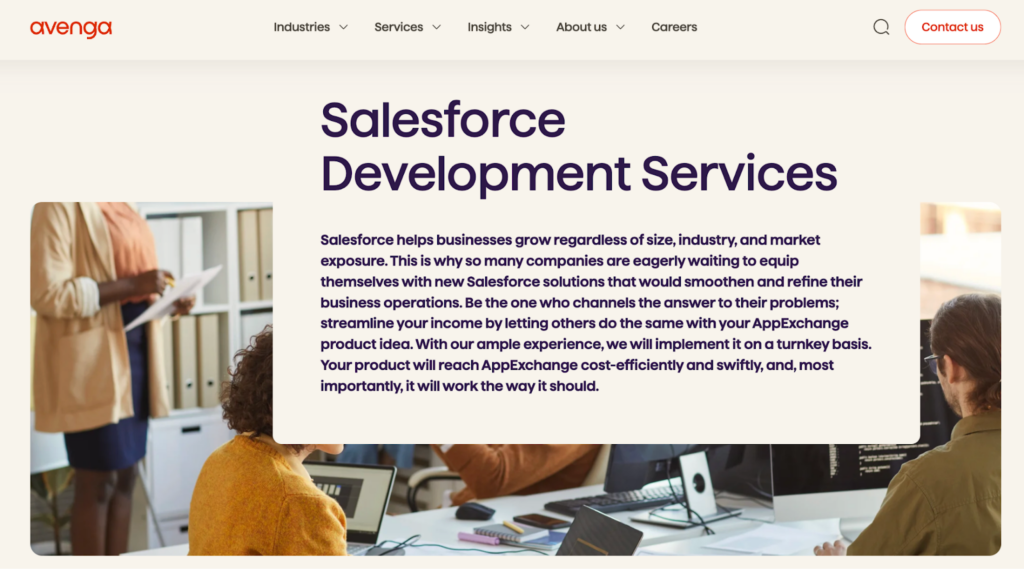
As a Salesforce development company, Avenga works with organizations building CRM environments that support complex operational processes.
In large companies, Salesforce often becomes a shared platform used by several teams at once. Sales pipelines, support workflows, marketing campaigns, and analytics dashboards frequently interact with the same underlying data.
Avenga helps organizations adapt Salesforce to that environment through customization, integrations, and platform development.
Salesforce development services typically include:
- Custom Salesforce development
- CRM architecture design
- Salesforce integrations with enterprise systems
- Data migration and platform optimization
- Ongoing Salesforce managed services
As CRM environments expand, new automation layers and system integrations tend to appear over time. Development teams continue refining the platform so it matches how different departments actually operate.
Organizations often rely on partners like Avenga when the goal is to maintain and evolve large Salesforce ecosystems.
2. Accenture

Accenture runs one of the largest Salesforce consulting practices in the enterprise technology market.
Many of its projects involve organizations deploying Salesforce across several departments or geographic regions. These initiatives often extend beyond CRM itself and include broader customer engagement strategies.
Accenture’s Salesforce services commonly include:
- Salesforce implementation and consulting
- Custom CRM development
- Enterprise system integration
- Customer experience platforms
- Long-term platform management
Large enterprises often treat CRM modernization as part of a broader transformation program. Salesforce becomes one piece of a larger digital environment connecting customer-facing teams.
3. Deloitte Digital
Deloitte Digital works on Salesforce programs that combine business strategy with technical implementation.
Projects frequently begin by analyzing how organizations interact with customers and manage internal workflows. Only after those processes are mapped out does the technical implementation begin.
Deloitte Digital’s Salesforce capabilities often include:
- Salesforce consulting and implementation
- CRM platform customization
- Customer experience transformation
- Integration with enterprise systems
- Data and analytics solutions
These programs typically involve coordination across multiple departments, which means the technical work often unfolds alongside organizational change.
4. Capgemini
Capgemini focuses on integrating Salesforce with broader enterprise environments.
In many organizations, Salesforce operates alongside analytics platforms, marketing systems, and internal applications. Ensuring that these systems exchange information consistently becomes a major part of the work.
Capgemini’s Salesforce services commonly include:
- Salesforce cloud implementation
- CRM modernization initiatives
- Data and analytics integration
- Platform customization
- Managed CRM services
The company frequently works with organizations running large Salesforce installations that span multiple teams or markets.
5. Cognizant
Cognizant works on Salesforce environments designed to interact with complex enterprise systems.
Customer platforms often exchange information with e-commerce software, marketing automation tools, support systems, and internal databases. Maintaining reliable data flows between these environments requires careful platform design.
Cognizant’s Salesforce capabilities often include:
- Salesforce platform customization
- Enterprise CRM integration
- Workflow automation
- Customer engagement platforms
- CRM analytics solutions
In many projects, the focus lies in ensuring that customer data moves smoothly across systems while the CRM platform remains stable.
6. Infosys
Infosys supports organizations expanding Salesforce across departments and international operations.
Many companies begin with a relatively small CRM deployment and gradually extend the platform to support additional teams. Over time, the system becomes more deeply integrated with internal processes.
Infosys’ Salesforce services often include:
- Salesforce consulting and implementation
- Custom application development on Salesforce
- Enterprise system integration
- Workflow automation
- Platform maintenance and support
For companies running global CRM environments, maintaining platform stability while the system continues evolving becomes a long-term responsibility.
When CRM Becomes Infrastructure
A lot of Salesforce projects start with simple objectives.
Track deals. Store contacts. Organize the sales pipeline.
But once the platform holds the company’s customer data, other systems begin connecting to it. Marketing tools sync campaigns. Service teams manage support requests. Internal reporting platforms draw analytics from the same environment.
Gradually, the CRM becomes something else.
Not just a tool used by one department — but a shared system supporting multiple business processes.
At that stage, maintaining the platform becomes an ongoing engineering task. Integrations continue appearing. Workflows evolve. Automation expands as teams rely more heavily on the system.
That’s why many organizations eventually collaborate with Salesforce development partners who specialize in keeping these environments stable while they continue to grow.